To navigate back to the KitUp app, click HERE.
Staying Safe with Miles Hill
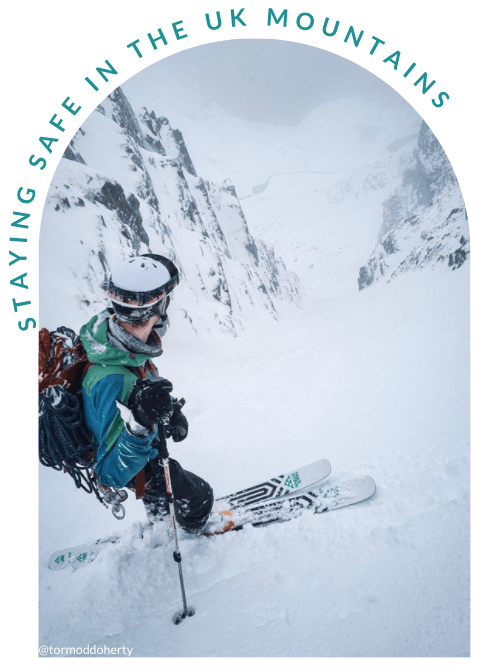
Welcome to ‘KitUp Stories’, a community that prides itself on our love of the outdoors. Every 2 weeks we will send out another story that will focus on adventure ideas, environmental issues, individual achievements and advice from the experts.
For our first issue, we tackle mountain safety! We can see from Tormod’s adventures (left) that storm Eunice brought some great winter conditions to the UK, but how can we minimise the risk of weather, cold and avalanche threat whilst out in the hills?
Miles Hill (below) has 20+ years of mountain experience, 8 of which have been working in mountain rescue. Earlier today we spoke to him about staying safe whilst enjoying the snow.

There is a common misconception that avalanches are only a serious threat in places like the Alps. In actual fact the risk of avalanche in British conditions can be even higher because of how unstable our weather systems can be in the winter months. From quickly looking at the Scottish Avalanche Information Service (https://www.sais.gov.uk/) we can see that there have been 8 recorded avalanches in the last 48 hours and over 200 this season! Now that we know this, lets speak to Miles and find out how we can properly manage the risk.
Miles, how real is the threat of avalanche in the UK and why do they happen?
“The threat is very real, although many never expect it to happen because the volumes of snow are less than in alpine environments. Our snow is wet and heavy which means that is doesn’t take much to form blocks of ice. As it is often shallow, avalanches tend to contain rocks and trees as well as ice. It is this debris that leads to serious injury. The most common is what we call spontaneous release, usually because of drastic changes in temperature and wind. That being said, we do see skiers and climbers triggering avalanches in the back-country”.

Miles, what are the main risks when exploring the mountains after storm Eunice?
“The risks differ between environments. In the mountains the wind will have created overhangs called cornices that may collapse, triggering what is called a wind-slab avalanche. This is because the wind has picked up the snow on one side of the mountain and dropped it on the other, making the snow unstable. In Moorlands and forested areas the risks will continue to be wind-based; trees coming down and debris being picked up. Many of these areas are just not used to such strong winds”.
How can we all stay safe and recognise these dangers?
“People need to plan properly and understand the risks. Check the forecasts, understand your own abilities and if in doubt, make the decision to turn around and go home, there is always next time! Local guides are a great way of building your own knowledge as they are so familiar with the area and conditions”.
What are the most common mistakes and how can we avoid them?
“A lot of climbers that I meet go out in winter conditions without transceivers, shovels or probes. These are essential to rescue anyone in an avalanche, so be prepared. A transceiver will get people to you, the probe will find you and the shovel will get you out alive. Always expect to be self-reliant in the hills. If the conditions get too bad, mountain rescue might not be able to get to you for some time”.
For those that want to get more expertise in operating in the backcountry, what courses would you recommend?
“First point of call, speak to local guides. They have so much knowledge and its great to support local businesses. For further info, the John Conville Trust run great courses with the British Mountaineering Council”. Both links can be found below :
Resources for Mountain Safety
– Snow and avalanche forecast for the UK: this is a MUST when planning to head out for any activity: www.snow-forecast.com/maps/dynamic/uk
– British Mountaineering Council: basic avalanche awareness: www.thebmc.co.uk/hill-skills-avalanche-awareness
– The John Conville Trust: providing young people with mountaineering courses: https://www.jcmt.org.uk/
– Ski Club of GB: how to manage the terrain and people when out ski-touring and mountaineering: www.skiclub.co.uk/info-and-advice/off-piste-and-touring
– Training for Trekking podcast: training tips, safety precautions and much more: trainingfortrekking.libsyn.com/
 blogkitupadventures.com